
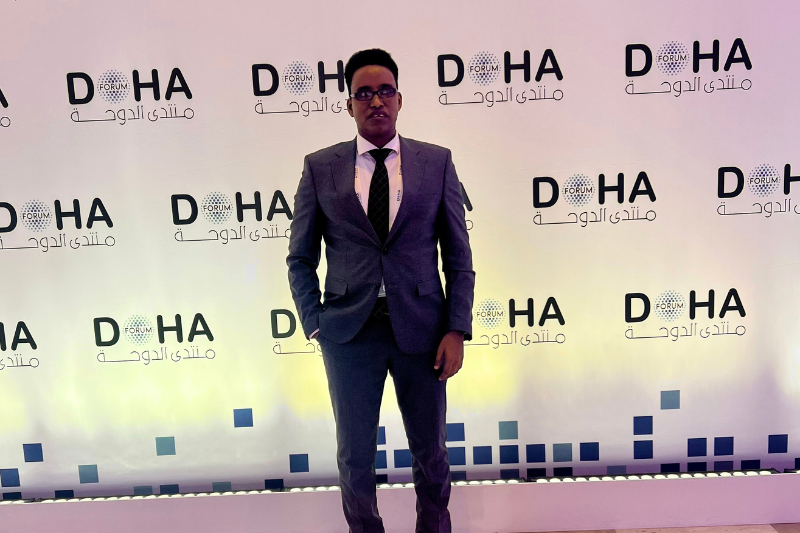
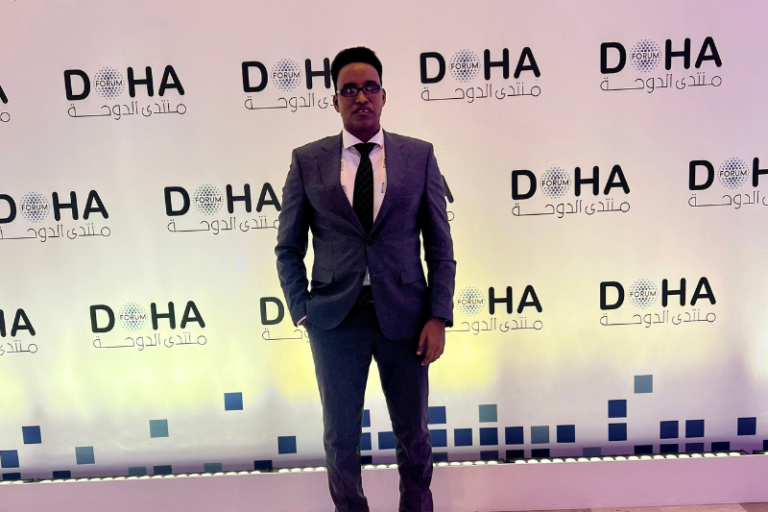
I received an invitation from the Doha Forum, the International Crisis Group, and the African Union Political Affairs, Peace, and Security Department on November 20 to participate as a speaker at the 23rd edition of the Doha Forum, held on December 6–7, 2025, at the Sheraton Grand Hotel in Doha. I was particularly invited to speak at a closed-door roundtable session titled “State-building in Somalia: Coordinated Strategies to Sustain Progress.” It was a great and rare opportunity to be invited as a speaker for my first time attending the Doha Forum. This year’s theme of the Doha Forum was Justice in Action: Beyond Promises to Progress.
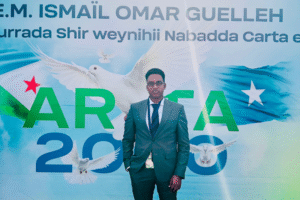
Although I miscalculated the travel dates and missed my flight, I managed to take an Ethiopian Airlines flight one day after my original travel schedule. The transit was only one hour. At Addis Ababa airport, as I proceeded to the departure gate for my flight to Doha, I met Omar Mohamood, an International Crisis Group researcher who was among the organizers of the closed-door roundtable session on Somalia. While queued in the departure line in Addis Ababa, he informed me that Somalia’s President would attend our session and deliver an opening speech.
The flight to Doha took off around 10 p.m. We landed at Hamad International Airport at 2 a.m.; it was the first time I had landed in Qatar. I was excited about the days ahead. The immigration process was smooth. While waiting for our luggage, Omar and I met Selam Tadesse, an Institute for Security Studies (ISS) researcher who was traveling on the same flight. Together, the three of us contacted the Doha Forum logistics team, who had organized transportation to the three hotels we were booked to stay.
There were drivers standing outside the airport, ready to pick up arrivals. I got a glimpse of how developed Doha is as we drove toward the hotels. I started testing my Arabic language and chatting with the driver. Passing tall buildings and well-lit streets, it was immediately clear that Doha is a modern and highly developed city.
The next day was Friday, and I had the opportunity to see around the city and meet several Somalis. Dr. Afyare Elmi, who luckily was staying at the same hotel as I was, took me around town. We first met with a diplomat working on the Horn of Africa. We prayed the Jum’a prayer in a mosque inside a large mall. Later, I had lunch with Dr. Afyare, Mursal Saney — the Executive Director of the Heritage Institute — and Anas, who lives and works in Doha, before sitting at Starbucks for coffee and a chat. We were looking forward to the Doha Forum and the invitation-only roundtable discussion on Somalia.
We went together to the Sheraton Hotel information desk, where I collected my speaker card and a VIP card for the invitation-only opening ceremony. Given the huge number of participants—over 5,000—the opening ceremony was attended by a selected group. As a speaker, I had the privilege of attending the opening ceremony held at Al Dafna Hall at the Sheraton Grand Hotel.
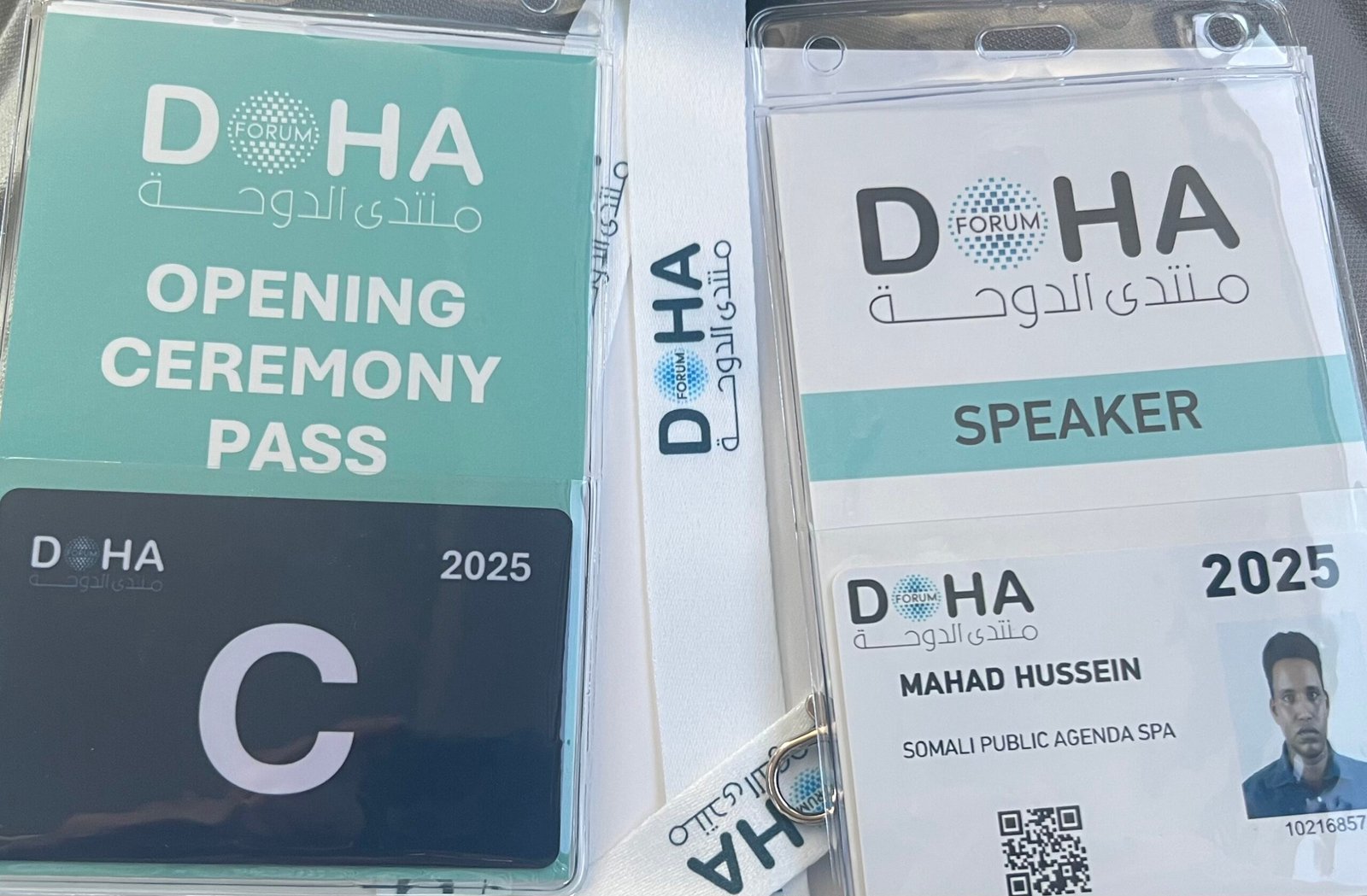
I arrived early in the morning to get a good seat. The opening ceremony started at 10:00 a.m. and lasted 30 minutes. The Emir of Qatar, Sheikh Tamim bin Hamad Al Thani; the Prime Minister and Minister of Foreign Affairs, Sheikh Mohammed bin Abdulrahman bin Jassim Al Thani; heads of state, including Somalia’s President Hassan Sheikh Mohamud and Syria’s President Ahmed Hussein al-Sharaa; heads of government; as well as high-profile guests such as Hillary Clinton and Bill Gates were among the attendees. Bill Gates was a keynote speaker and spoke about the work the Gates Foundation is doing and the global initiatives it supports.
One tradition of the Doha Forum that I particularly appreciated is its recognition of individuals and organizations engaged in courageous and transformative work. This year, the forum honored Alex Thier and Saad Mohseni for their contributions to advancing children’s education in Palestine and Afghanistan. The awards were presented by the Emir of Qatar.
Following the opening ceremony, parallel sessions began. On the first day, I attended several panels, including “Mediation in a Time of Fragmentation,” which featured Sheikh Mohammed bin Abdulrahman bin Jassim Al Thani; Kaja Kallas, High Representative for Foreign Affairs and Security Policy and Vice President of the European Commission; José Manuel Albares, Spain’s Minister of Foreign Affairs; and Hakan Fidan, Türkiye’s Minister of Foreign Affairs. The session was moderated by Christiane Amanpour, CNN’s Chief International Anchor.
Another interesting session was the Newsmaker Interview with Ahmed Al-Sharaa, President of Syria. He had an engaging discussion with CNN Chief International Anchor Christiane Amanpour, receiving strong support and applause in Al Dafna Hall. I also attended the session “Navigating Disruptions to Global Health Financing: Strategic Partnerships to Reclaim Country Ownership,” in which Somalia’s Minister of Health, Dr. Ali Haji Adam, was among the panelists.
The Doha Forum had invitation-only sessions that were not recorded. I was invited and joined one titled “Yemen After the Gaza Ceasefire: Scenarios for De-escalation and the Future of the Peace Roadmap,” with speakers including Hans Grundberg, the United Nations Special Envoy to Yemen, and Dr. Abdullah Al-Alimi Bawazeer, Vice President of the Presidential Leadership Council (PLC).
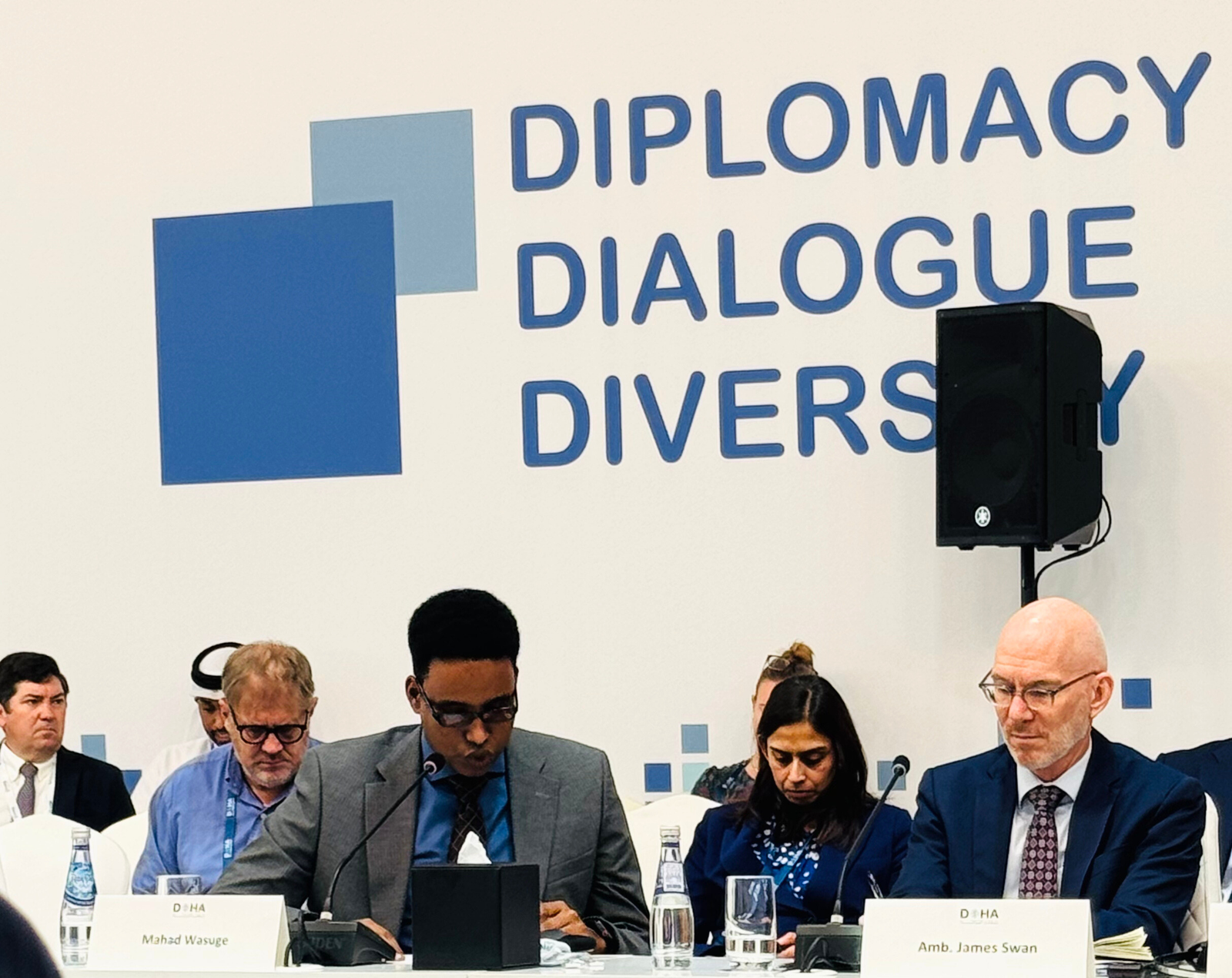
The Somalia session took place on the morning of the second day and was the first session of the day. I was the only Somali representing a non-governmental organization in a room largely filled with government officials. I was asked to frame the discussion on state-building in Somalia, explain why progress has been slow, outline the conditions necessary for a smooth electoral cycle, and suggest how the international community can more effectively support Somalia’s path forward given current realities. The session began with opening remarks by the President, followed by discussions on security transition and elections.
The Doha Forum was well organized, with large screens throughout the venue displaying ongoing and upcoming sessions, complemented by a comprehensive mobile app. Given the high-profile nature of its participants, the Doha Forum generated global media attention. Prominent journalists such as Tucker Carlson, James Bays of Al Jazeera, Ravi Agrawal of Foreign Policy, and Christiane Amanpour moderated various sessions. One-on-one conversations featured figures such as Hillary Clinton and Donald Trump Jr.
With more than 5,000 attendees, the forum provided an exceptional opportunity for networking and engagement. Among the many people I met for the first time were Alex de Waal, Executive Director of the World Peace Foundation; Dr. Comfort Ero, President and CEO of the International Crisis Group; Itonde Kakoma, President and CEO of Interpeace; Ahmed Soliman of Chatham House; Clionadh Raleigh, President and CEO of ACLED; Elizabeth Sidiropoulos of the South African Institute of International Affairs; and Cedric Barnes of the UK’s FCDO, who supported Somali Public Agenda in early 2018.
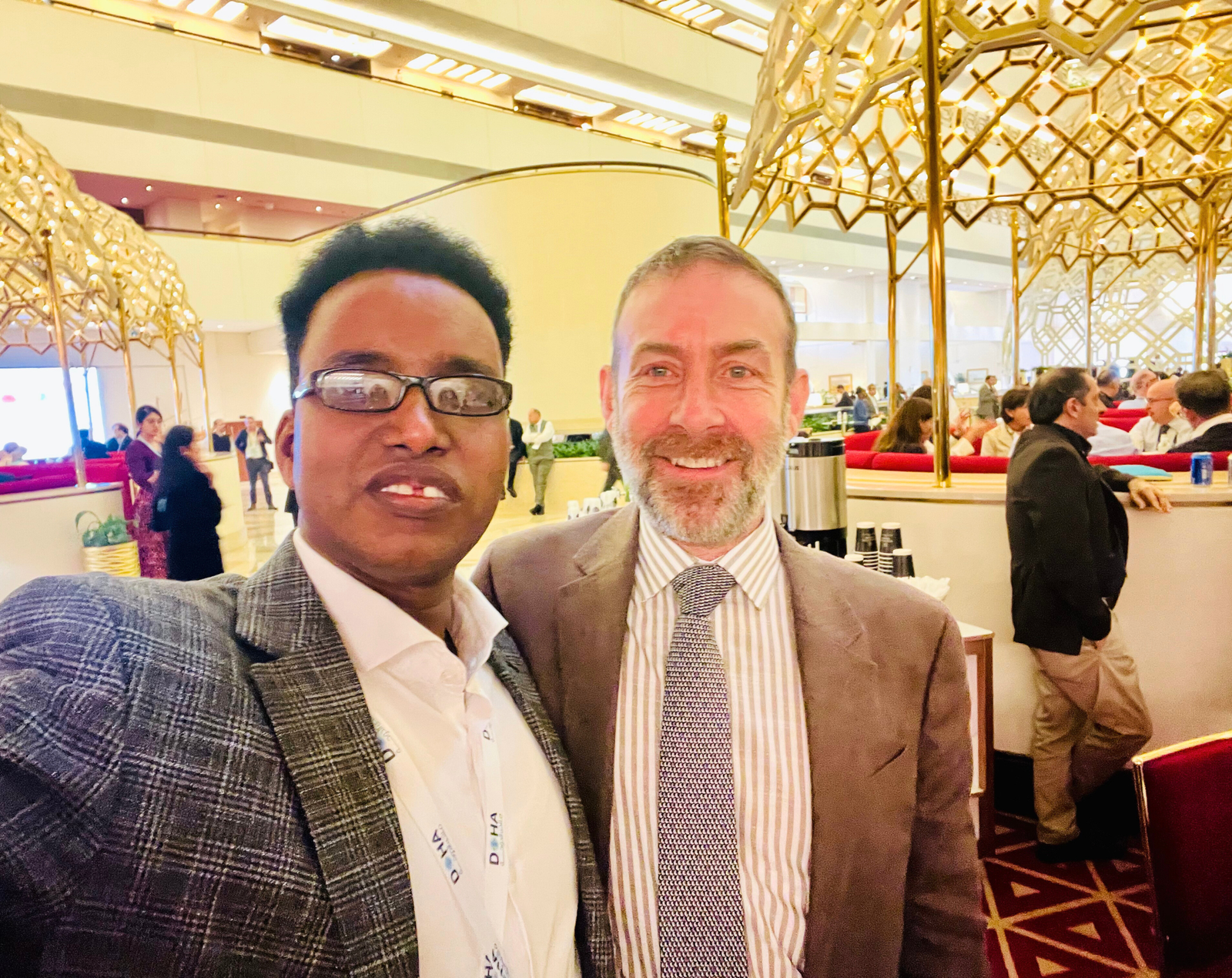
Dr. Abdullahi Hussein, who lives in Doha, took me around the city, particularly the old town. I learned more about the city as we chatted one evening. We discussed education and research in Somalia, including some of his research on Somalia’s education system. I also had a long walk with Dr. Afyare one night, during which we discussed Somalia as we usually do. I used Uber and was surprised at how affordable the fares were.
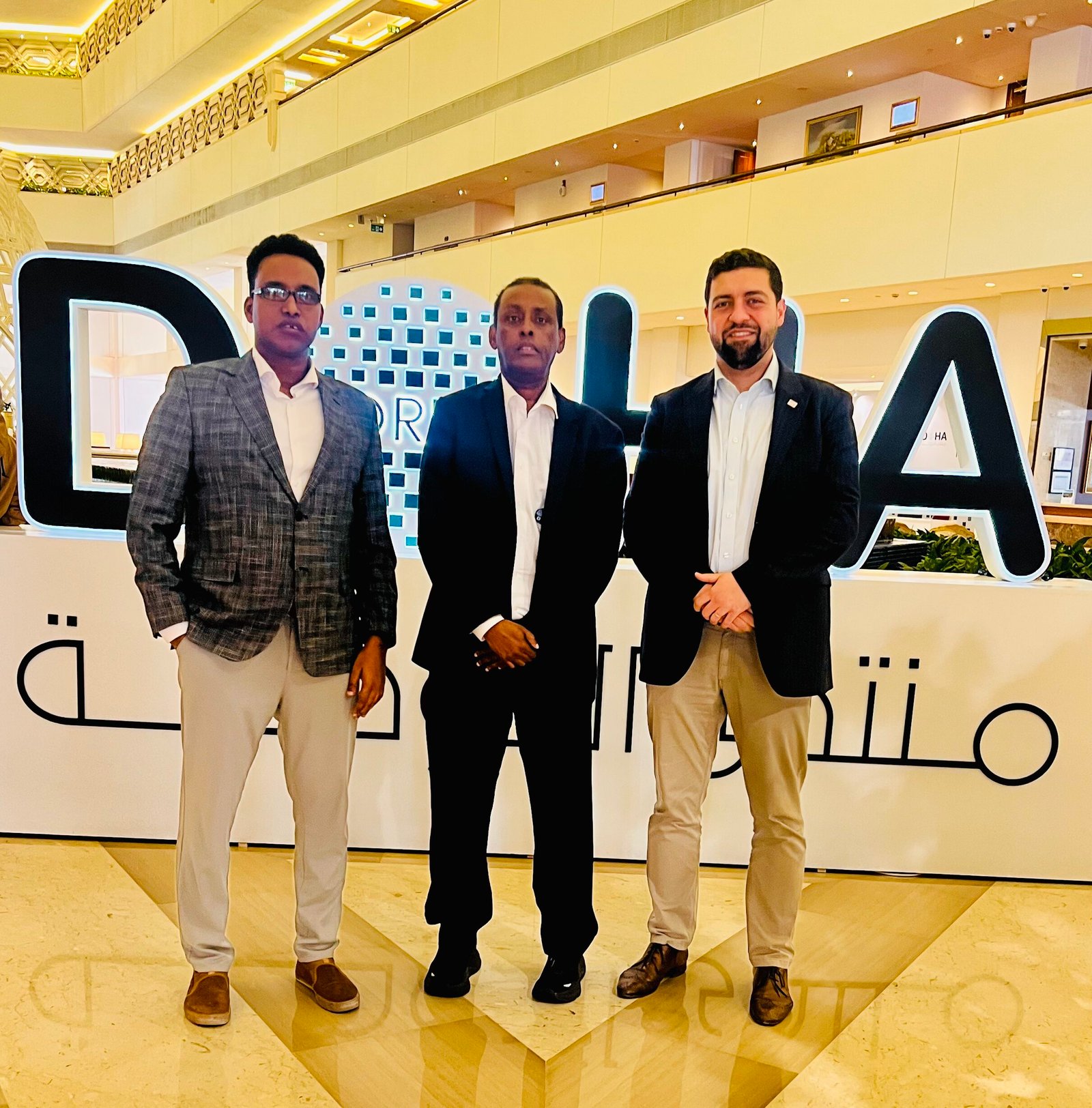
Although I stayed in Doha briefly, I had the opportunity to engage and connect with many people. The discussions at the Doha Forum were of high quality. Shoutout to the organizers of the Doha Forum, who made managing such a large event and bringing together over 5,000 people look easy. I will miss Doha, and this will certainly be the first of many trips in the future.
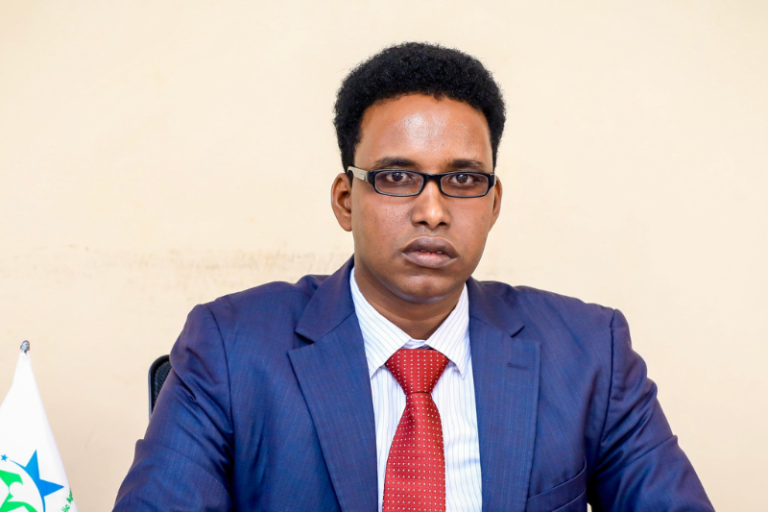
Is a researcher, teacher, podcaster and blogger. His work over the last decade has focused on teaching and researching governance, justice and social services in Somalia.



One Response
Really enjoyed reading this insightful reflection, Mahad! Very much liked how you emphasized and it’s a great reminder that diplomacy is about people as much as politics.